


Feeding thousands of children every week in rural Africa requires a system that can move food consistently, partnerships that can sustain supply, and local networks that ensure it reaches the children who need it most.
At Heart for Africa, this work happens through a community feeding program designed to do exactly that. Each week, more than 6,000 children in rural Eswatini receive meals through a coordinated effort that brings together international food partners, local churches, and a structured distribution network built over time.
This is what it takes to fight hunger in a way that is reliable, not occasional. It is not a single delivery or a one-time response, but a system that functions week after week, year after year.
Understanding how that system works helps explain not only how food reaches children, but why consistency is one of the most important factors in addressing hunger long term.
Why Hunger Persists in Rural Africa (and Why Access Matters More Than Supply)
In rural communities, the issue is rarely as simple as food being entirely absent. More often, it is the reliability of access that creates the greatest challenge.
Families may live far from consistent food sources, and transportation infrastructure can make it difficult to move goods efficiently between regions. Economic limitations also play a role, as even when food is available, it may not be affordable on a regular basis. Agricultural cycles further complicate the picture, since food availability can fluctuate with seasons, weather conditions, and local production capacity.
As a result, many children grow up with meals that are irregular or lacking in key nutrients. Over time, this creates a pattern where food insecurity is not defined by constant hunger, but by inconsistency. It is this pattern that community feeding programs are designed to address.
What Community Feeding Programs in Africa Actually Do
A community feeding program is often understood as a way of distributing food, but in practice, the work is far more structured than that. At its core, it is about building a system that can deliver meals in a consistent and dependable way.
This requires more than securing food supply.
It involves developing relationships within communities, establishing reliable distribution points, and ensuring that the food being provided contributes to proper nutrition rather than simply meeting short-term needs. When these elements are in place, feeding programs begin to function less like one-time interventions and more like ongoing support systems that families can depend on.

How Food Is Distributed to Children in Rural Africa
Heart for Africa’s Hunger Initiative is built around this idea of consistency, with a model that connects food supply, partnerships, and local distribution into a coordinated effort.
Rather than attempting to distribute food directly from a central location (which would make it nearly impossible for all of the children to access food across the country) the program works through established relationships with churches and community partners across rural areas.
These local partners play an essential role in identifying children in need and ensuring that food is distributed in a way that is both organized and dependable. Because these relationships are rooted in the community itself, they create a level of trust and continuity that would be difficult to achieve through external distribution alone.
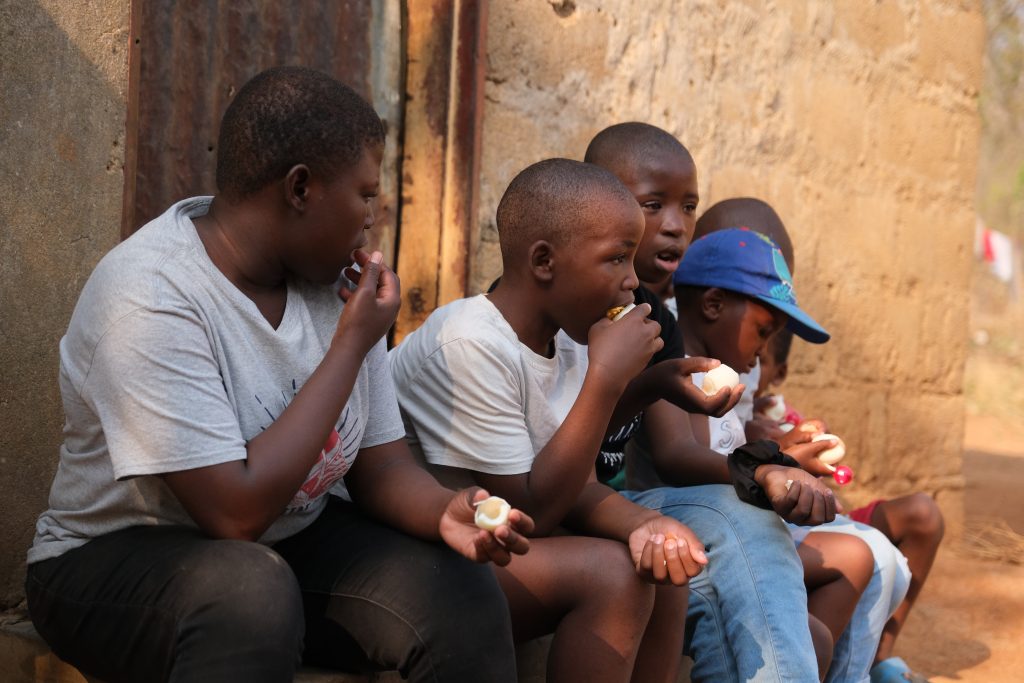
The food provided through the program is selected with nutrition in mind. Children receive meals such as MannaPack™, supplied through Feed My Starving Children, along with eggs and other staple foods that help support a more balanced diet. This combination reflects an understanding that addressing hunger requires more than calories alone. It requires access to nutrients that support growth and development over time.
Today, the Hunger Initiative reaches more than 6,000 children each week in rural communities across Eswatini. This level of consistency allows children to rely on the program as part of their weekly rhythm, rather than experiencing it as occasional assistance.
Partnerships play a central role in making this possible. Organizations such as Gleanings for the Hungry and Egg Farmers of Canada contribute food resources and logistical support that help sustain the program at scale. Each partner brings a different strength, and together they form a network that is capable of reaching communities that might otherwise remain underserved.
One of the most significant components of this effort is the egg distribution program supported by Egg Farmers of Canada. Eggs provide a reliable source of protein and essential nutrients, which are particularly important in areas where access to protein can be limited. Between 2016 and the end of 2026, approximately 16 million eggs will have been distributed through this initiative. This consistency is what allows the program to contribute meaningfully to children’s diets, rather than functioning as a one-time supplement.
The Role of Partnerships in Fighting Hunger in Africa
Addressing hunger at this scale requires collaboration. No single organization has the capacity to source, transport, and distribute food across multiple regions while maintaining consistency over time.
Partnerships allow different organizations to contribute where they are strongest. Some provide food resources, others contribute logistical expertise, and local partners ensure that distribution happens effectively within communities. When these pieces come together, they form a system that is far more resilient than any single effort could achieve on its own. If you are interested in fighting hunger with us as a partner, you can connect with us directly, here.
This collaborative approach is not only practical, but necessary for creating programs that can operate reliably in complex environments.
Why Long-Term Solutions Are Essential to Address Hunger in Africa
Feeding programs are an essential part of addressing hunger and malnutrition, but they are not the only piece of the solution. Long-term progress depends on strengthening the systems that support food access more broadly.
At Heart for Africa, the Hunger Initiative exists alongside other efforts connected to agriculture, sustainability, and community development. While these areas serve different purposes, they are connected by a shared goal of improving stability over time.
This reflects a balance that is common in effective development work. Immediate needs must be addressed in the present, while longer-term systems are developed to reduce vulnerability in the future. Both require intentional planning and consistent effort.
Why Consistent Access to Food Matters for Children in Africa
Consistent access to food has a direct impact on a child’s daily life. It influences physical health, supports cognitive development, and contributes to a greater sense of stability within families and communities.
When meals are reliable, children are better able to focus in school and participate more fully in daily activities. Over time, this consistency creates a foundation that supports growth in other areas of life. Without it, progress in education and development becomes significantly more difficult to sustain.
For this reason, feeding programs that operate with consistency and structure play an important role in supporting children beyond immediate nutritional needs.
Looking Ahead
Hunger remains a complex global challenge, particularly in rural regions where access to food is shaped by multiple factors. At the same time, programs built on strong partnerships and reliable systems demonstrate that meaningful progress is possible.
Heart for Africa’s Hunger Initiative offers one example of how nonprofits are working to address food insecurity in a practical and sustained way, reaching thousands of children each week through coordinated effort and long-term commitment.
To learn more about the work taking place in Eswatini or to stay connected with ongoing initiatives, you can visit Heart for Africa’s website below for updates as the organization continues to build and refine these programs over time.